Aliasing Ocaml Programming Chapter 7 Video 4 Information Center
Get comprehensive updates, key reports, and detailed insights compiled from verified editorial sources.
Key Details

Explore the primary sources for Aliasing Ocaml Programming Chapter 7 Video 4.
Expert Insights
Data is compiled from public records and verified media reports.
Last Updated: June 17, 2026
Summary

For 2026, Aliasing Ocaml Programming Chapter 7 Video 4 remains one of the most searched-for profiles.
Video Highlights & Reports
Below is a handpicked selection of video coverage regarding Aliasing Ocaml Programming Chapter 7 Video 4.
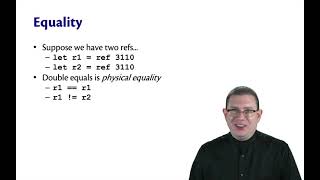
Aliasing | OCaml Programming | Chapter 7 Video 4
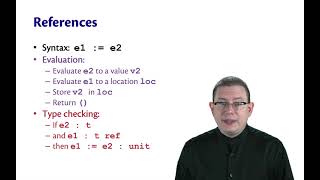
Syntax and Semantics of Refs | OCaml Programming | Chapter 7 Video 2
Trees with Map and Fold | OCaml Programming | Chapter 4 Video 7
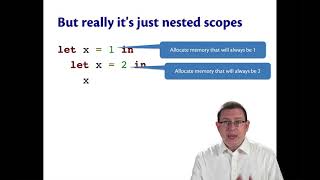
Scope and the Toplevel | OCaml Programming | Chapter 2 Video 7
Recent Updates
Stay updated on Aliasing Ocaml Programming Chapter 7 Video 4's latest milestones.

Overview of Aliasing Ocaml Programming Chapter 7 Video 4

How to use the ideas of `map` and `fold` functionals with binary trees. Textbook: What looks like mutability in the toplevel is not -- it's really just a consequence of scope. Textbook: ... References, or ref cells, are pointers to typed locations in memory. They enable imperative The semicolon operator is used to sequence imperative commands Textbook: A deep dive into implementing lists with mutable fields Textbook: The second part of a deep dive into implementing lists with mutable fields. Textbook:
Application of functions to "too few" of arguments, and syntactic sugar. Textbook: How to implement queues functionally, and how to improve efficiency by using two lists instead of one. Note that the textbook now ... How to implement a Map ADT with association lists as the rep type Textbook: Examples of pattern matching with lists, records, and tuples. Textbook: Functional data structure do not use imperative features, hence are persistent rather than ephemeral Textbook: ...
Disclaimer:


